
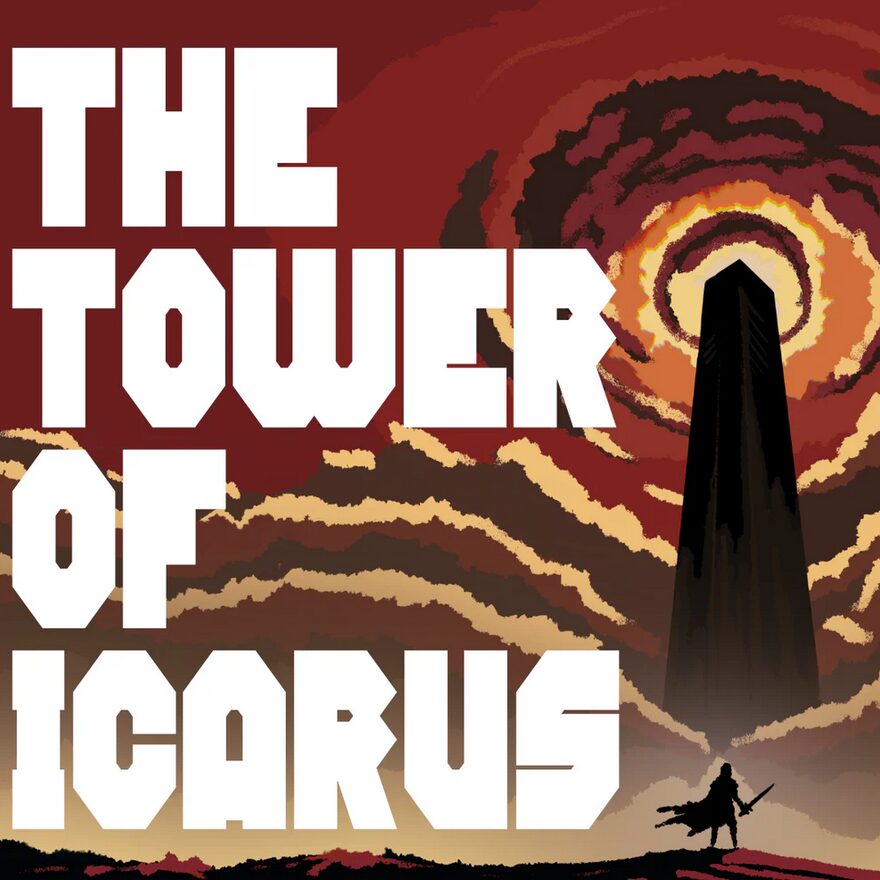
The Tower of Icarus is a free brochure game made by Ravensridge Co (who I will refer to as Ravenridge for this review) for the One Page RPG Jam of 2025. In it, you play a terrible, awful human who has become deluded and hellbent on scaling the Tower of Icarus. But, if you know how the tale of Icarus goes, those delusions won’t hold forever as they near the sun.
One of my big wishful thinking plans for late 2024 was to build a Solo RPG kit. A repurposed tech case that could hold dice, a journal, a pen, cards, and whatever small games I could fit for play on the go in an analog format. Something akin to Gray Army Gaming’s Kit.
By 2025, I’d succeeded in the harder task of finding an appropriate tech case to hold my kit, and now I was hellbent on sniffing out some delicious solo RPGs to fuel my collection. Digging through my itch.io library after a multiplayer TTRPG session fell through, I uncovered this gem in the related games section for a different title.
Enthralled by the art and graphic layout, and the subtitle of “a solo RPG of misplaced ambition” I snatched a copy and played through a session right then and there.
11 – A sphinx coils atop the door handles. “What do you call a blind man who sees? A fool.”
Confrontation: I use my Wit to find another valid response to the riddle that frees me of any true self-reflection. (5 – Fail)
Confrontation: I use my Grace to try and convince the sphinx I believe it. (8 – Fail)
Confrontation: I use my Might to bitch-slap the sphinx. (14 – Success)
Lo and behold The Tower of Icarus was the first solo RPG to find a place in my new kit, and I’ve quite often gone back to it and played it numerous times to the point where when I sat at my computer to write my first review of 2026, I just had to talk about The Tower of Icarus.
Design & Layout
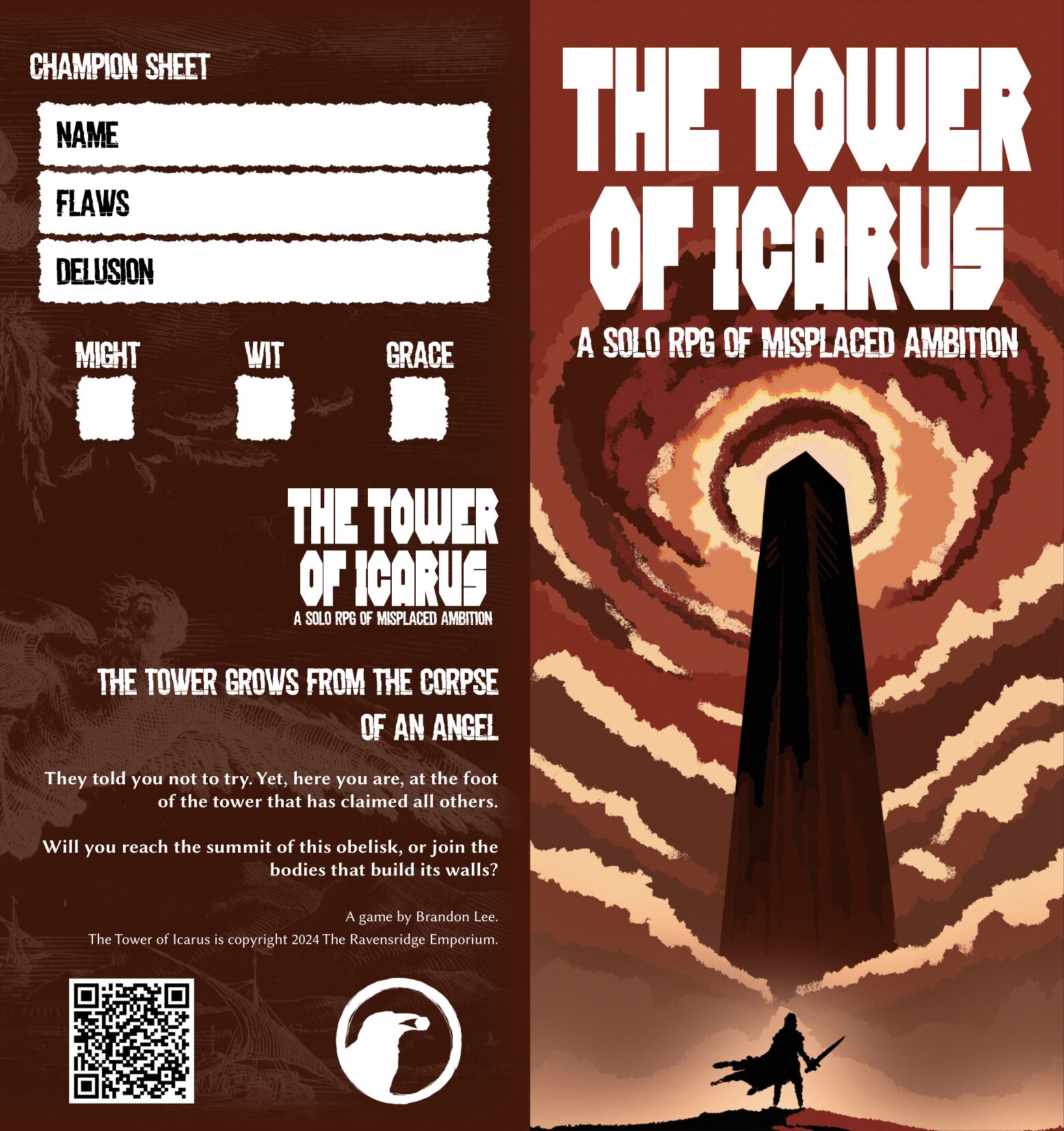
The Tower of Icarus only has one clear ‘hero’ illustration to sell itself off of. And that is what you see above, the obelisk tower, surrounded by dark clouds and a glowing radiant light behind it, with the foolish ‘hero’ in the foreground. There is something grand about it, in its simplicity. It’s an incredibly striking image, and its simple flat-art style with minimal texture and busy-ness only exemplifies this.
It reminds me of the illustrated covers for Ayn Rand’s books, ‘Atlas Shrugged’ and ‘The Fountainhead’, particularly those designed by Nick Gaetano. My only exposure to those books are brief mentions in video essays and behind the scenes videos for the video game Bioshock and its sequels. But even now those striking images persist.
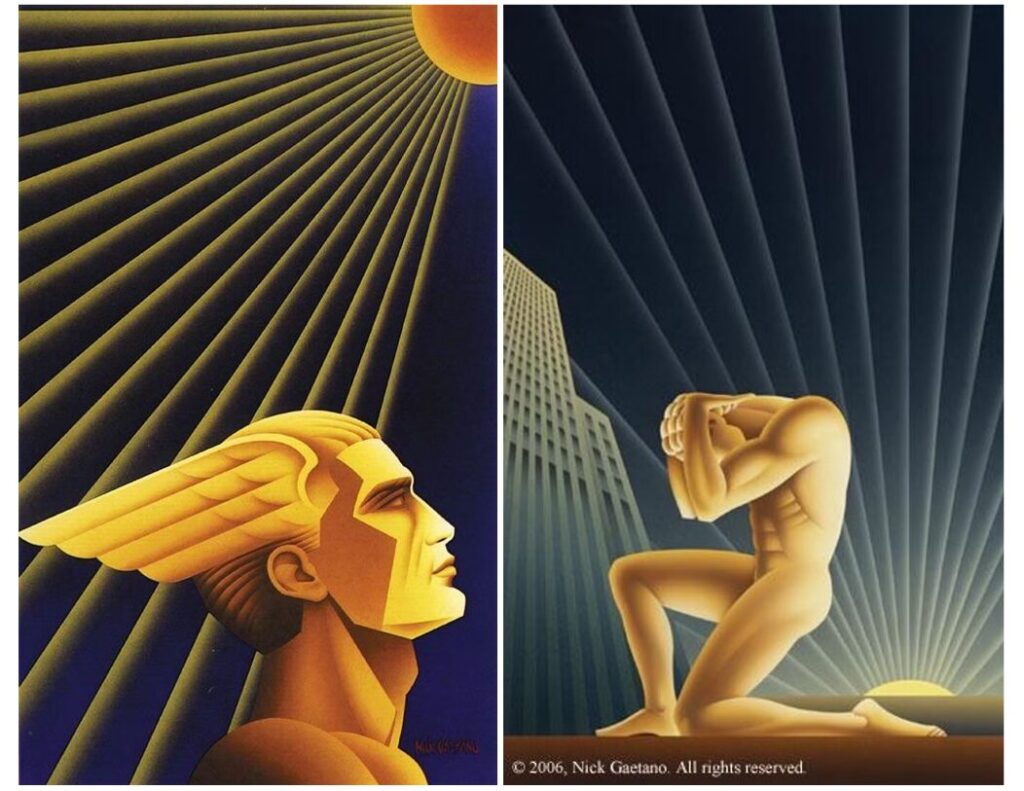
Right: The illustrated cover for Ayn Rand’s Atlas Shrugged by Nick Gaetano.
Both feature an art deco/flat graphic style that captures a sort of mythological ephemera. There’s a misplaced grandeur in these pieces that I can’t quite put my finger on. Especially the fountainhead. Those rich dark blues unsettle me, along with how the main figure dances the line between human and not enough yet those harsh shadows under his chin and along his cheekbones suggest otherwise.
Though this grand hero image is not the only piece of art present on the brochure. In the background of the back panel you can see the faded image of an Icarus art piece, though I could not source the original artwork. And on the inside left panel is a simple graphic of loose black feathers floating across the bottom of the page. These inclusions are tasteful, and don’t make the layout feel too busy.
For those unfamiliar with the Icarus myth, he and his father Daedalus were trapped in a tower. In most myth retellings this was a result of Daedalus inventing the Minotaur maze. Nevertheless, Daedalus invents a set of wings out of wood, tar and feathers, to fly out of the tower and escape. Both he and Icarus set off, but Icarus is so smitten by the experience, he tries to see how high he can go. He flies towards the sun, and the heat of its rays melts the tar, loosening the feathers, and causing the contraption to cease working. Icarus then falls to his death, right in front of his father.
The word Icarus is a solid method to encapsulate the themes of the tower. If you know the myth, you can immediately pick up what concepts may be explored in the game: hubris, devastating failure, delusion perhaps and tragedy. Whether Icarus is as dastardly as some of the fools you can send into the tower though is another discussion.
If there’s one thing that irks me about The Tower of Icarus, it’s a particular choice in the layout. The Getting Started section is on the last to read panel, par perhaps the character sheet, and is placed after the section describing how the game can end. That, plus its placement on the darker box, originally caused me to completely miss this section on my first playthrough. I just started rolling on the table and figuring it out as I went.
If I had to redesign The Tower of Icarus from scratch, I would move Getting Started and the Flow of the Game diagram to the centre panel alongside Ascending the Tower, then move Obstacles and How to Die to the right, placing the Hubris section in its own red box.
Mechanics in The Tower of Icarus
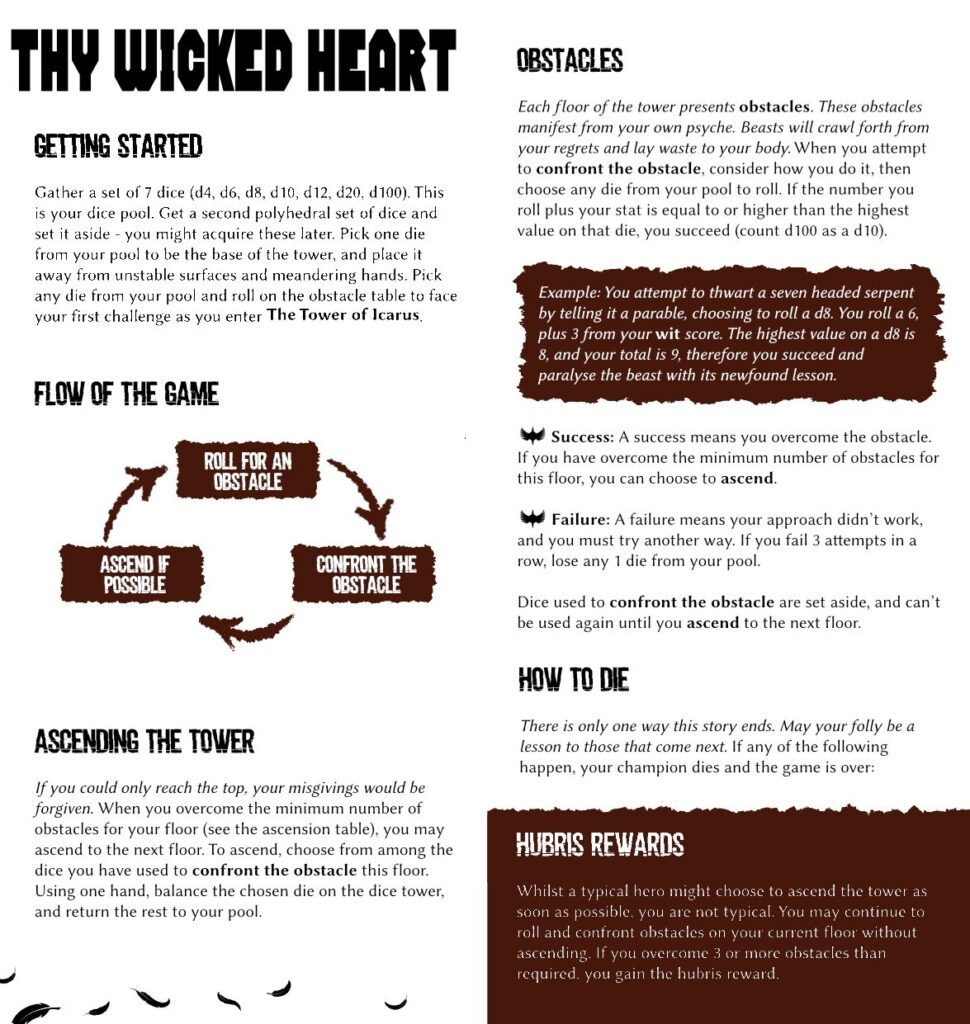
The Tower of Icarus’ gameplay loop is simple and easy to understand. You have access to a full set of dice, (d4, d6, d8, d10, d12, d20, d00) and can pick whichever to roll on the Obstacles table. This introduces an enemy, situation, or effect that impedes your hero’s progress, alongside a question typically on how the situation relates to your hero. Personalising the situation, as you do.
You then select a different dice to roll, add one of your three stat modifiers (Might, Grace or Wit) and try to score more than your first dice roll. On a success, you take the very first dice you roll, and begin to build a dice tower.
If you fail, you get two more attempts to surpass the obstacle before you start getting punished. For every fail beyond the first 3, you lose 1 dice from your dice pool.
There’s more to it, Hubris rewards and retrying the same floor, alongside extending the game with additional dice sets. It all keeps going until you either run out of dice, or the tower crumbles.
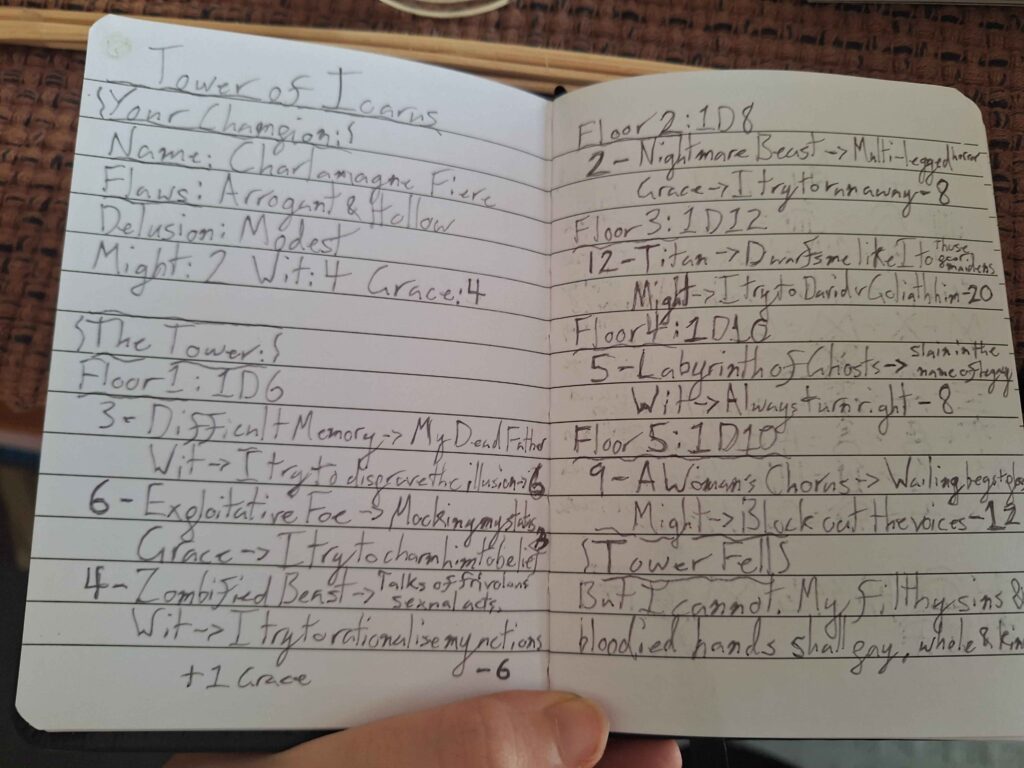
I enjoyed the encounters, they felt varied enough that repeat playthroughs didn’t feel too repetitive. The use of Flaws and Delusions to feed the more nuanced questions helped even repeat monsters feel different in their motives or methods.
A common issue I find in games where a character sheet has an empty box, is that they say “fill this with any phrase you can think of to represent a flaw, motive, dark secret, etc.” and I can never have a good solid idea. Sometimes I just end up stuck, or go so far off what is designed and expected that my GM rejects the character sheet back at me to fix. Which when I spent an hour struggling to come up with one sentence in the first place is a sure-fire recipe to drop the system entirely.
The Tower of Icarus avoids this by giving you a short list for the Flaws, enough to easily have a diverse pickings while also giving a large enough sample size for you to confidently come up with your own.
Alongside this, the delusion, which has no list to pull from, is described as an ‘inverse of one of your Flaws’. This immediately spikes the imagination (or gets the thesaurus off the shelf) and prevents any of those blocks of “dear god what do I write here?”
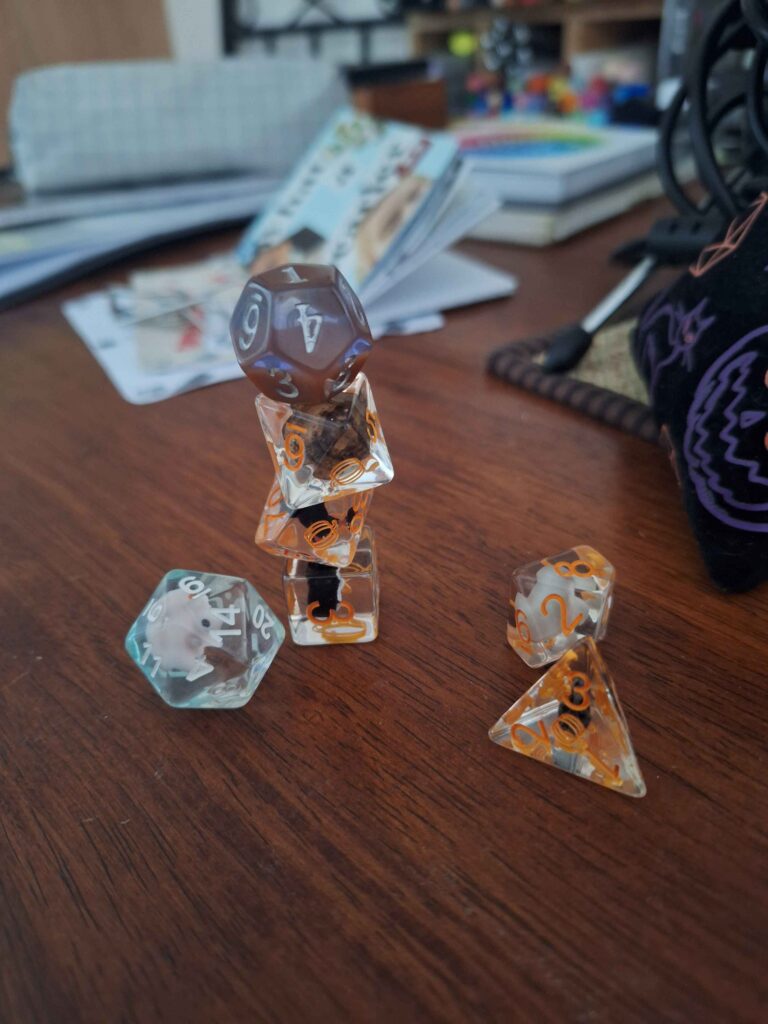
I am not the biggest fan of dexterity-based mechanics. They aren’t very accessibility friendly for those with shaky hands or poor eyesight. That said, I appreciate their tactile nature. I can see solid thematic concepts that wooden blocks or dice towers can lean nicely to, and The Tower of Icarus is no exception.
Dare I say I enjoy the dice tower more, purely because it is smaller scale, meaning less set-up time, less clean-up when it tumbles, and it’s easier to carry around in a travel kit. A lot of TTRPG players are going to have lots of dice, fewer will have a wooden block tower. (Though that may change as the prevalence of the Wretched & Alone games and other games like Pirouette grow in popularity.)
The one issue players have made note of with the game mechanically, is the d4. Most traditional dice sets come with a triangular d4, aka a dice that ends in a point. Balancing any dice on top of this is nigh impossible for the common player. When this issue was brought up on the itch page, the people at Ravensridge had this to say:
“That’s the point! There’s no way to win the game, just as there was no way for Icarus to avoid his fate once ambition took him. That rule exists for the talented few who can balance on a d4, or the folks who have abnormal d4 shapes.” – Ravensridge
But I don’t believe that it’s a gameplay problem at all, not to the keen-eyed player. You see, in order to unlock your second set of dice and continue playing the game, the brochure says:
“If you reach floor seven of the tower, collect another set of seven polyhedral dice, add them to your pool and continue climbing.”
Note how it says you don’t need to use all the dice of your original lot. Now, this game uses something called “Hubris Rewards”, face three obstacles on the same tower floor, then you earn a reward. This ranges from stat improvements to the most important: more dice.
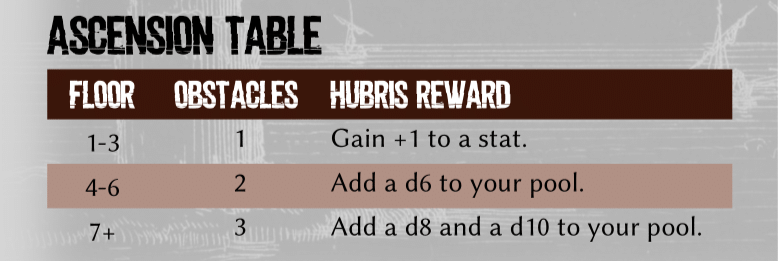
From as early as floor 4, you can start earning D6s to your pool, using Hubris rewards, you can easily push yourself further into the game, without using those D4s for the tower.
That said, the more dice you use in the tower, the less you have for facing obstacles, and eventually, you may find yourself faced with the consequences of your hubris: Trying to pass a level 20 test with nothing more than a d4.
Conclusion
Death appears at the end of the bloodshed, the bell tolls, ringing in my skull, I grasp my head, the disease in my bones seep deeper, grasping its clawed grip around my soul. I am impure. I am Sin. Tears stream down my dirt-crusted cheeks. A skeletal hand rests on my shoulder, bony phalanges dig into my shoulder. The journey ends here. The delusion ends here.
The Tower of Icarus will remain a mainstay in my TTRPG kit for a long time. It’s easy to set-up, concise, and dripping in theme and roleplay potential. One can easily take either no notes at all, or write a whole fiction on their foolish ‘hero’ and their futile climb toward the unachievable.
I’ve picked up more of Ravensridge’s games for my birthday too, including Caught in the Rain. So perhaps you can expect more of their work on this blog in the future. 😉
Nevertheless, I’d highly recommend The Tower of Icarus if you enjoy the one page RPGs, or want something quick to spin up and play through when your multiplayer group cancels at the last minute.
- Playtime: 1 hour – 1 hour and 30 minutes.
- This Game Is: Clean, Portable & Thematic.
- Final Rating: 5 Tar-Soaked Feathers.
More from Ravensridge Co:
- Get The Tower of Icarus Here
- The Ravensridge Emporium
- The Ravensridge Press
- Follow Ravensridge Emporium on Bluesky
- Check Out Other Submissions to the One Page RPG Jam 2025

(It/They/Him)
Independent Game and Graphic Designer based in Australia.
I make physical tabletop games, primarily roleplaying, but I haven’t shied away from card games in the past.
My main focus now is solo games, both playing, creating, and reviewing.